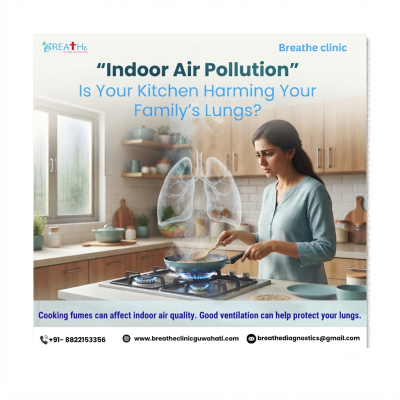
Indoor Air Pollution: Is Your Kitchen Harming Your Family's Lungs?
When we think about air pollution, we picture traffic, smog, and factory chimneys something that happens outside, out there. So it comes as a surprise to many of our patients when we tell them that the air inside their own home, particularly in the kitchen, can sometimes be more harmful to their lungs than the air on the street.
At Breathe Clinic Guwahati, near Khanapara on G.S. Road, we see the effects of indoor air pollution regularly in homemakers who spend hours at the stove, in children growing up in smoky kitchens, and in elderly family members whose coughs never quite settle. It's one of the most under-recognised respiratory risks in our region, and the good news is that much of it is preventable. So we've put together this blog in the simple question-and-answer format our patients usually use when they ask us about it in the clinic.
Is indoor air really a problem? Isn't outdoor pollution worse?
Both matter but indoor air deserves far more attention than it gets. We spend a large part of our day indoors, and in a closed or poorly ventilated home, smoke and fumes have nowhere to escape. They build up and linger, which means the people inside breathe them in again and again, often for hours at a stretch. For families that cook with wood, coal, or dung, the kitchen can become the single most polluted place the family spends time in.
What exactly is polluting the air in my kitchen?
It's usually a combination of things, and not all of them are obvious:
• Smoke from biomass fuels wood, coal, cow dung, and crop residue release large amounts of fine smoke and soot when burned, especially in traditional stoves.
• Cooking fumes even on a gas stove, frying, searing, and high-heat cooking release fine particles and gases into the air.
• Poor ventilation a kitchen without a window, chimney, or exhaust fan traps everything the cooking produces.
• Mould and damp common in humid homes, and a frequent trigger for allergies and asthma.
• Other indoor sources mosquito coils, incense, indoor smoking, and strong cleaning chemicals all add to the load.
Why is cooking smoke so bad for the lungs?
The smoke from burning biomass is full of fine particulate matter — tiny particles small enough to travel deep into the lungs and stay there. Over months and years of daily exposure, this causes ongoing irritation and inflammation in the airways. It's not a one-time harm; it's the slow, repeated exposure, day after day, that does the damage.
Who in the family is most at risk?
This is the part we really want families to understand. The burden doesn't fall evenly:
• Women, especially homemakers, who often spend the most hours near the stove.
• Young children, whose lungs are still developing, and who are frequently carried or kept close to the cooking area.
• Elderly family members, who may already have weaker lungs or other health conditions.
• Anyone with existing asthma, allergies, or COPD, for whom kitchen smoke can trigger flare-ups.
What symptoms should make me think about indoor air?
These signs are easy to dismiss as “just the cooking” or “a weak chest,” but they're worth paying attention to particularly if more than one person at home has them, or if they ease when you're away from the house:
• A persistent cough, especially during or after cooking
• Frequent throat or eye irritation
• Breathlessness or wheezing
• Repeated chest infections
• Worsening asthma or allergy symptoms at home
If any of these last beyond two to three weeks, it's worth getting checked by a pulmonologist rather than waiting it out.
What can I do to protect my family?
You don't need to rebuild your kitchen to make a real difference. Small, practical changes add up:
• Ventilate while cooking open a window, use an exhaust fan or chimney, and let the smoke out rather than letting it settle.
• Switch to cleaner fuel where possible LPG or electric cooking produces far less harmful smoke than wood, coal, or dung.
• Keep children away from the cooking area, especially when the stove is lit.
• Maintain your stove and chimney so they burn efficiently and vent properly.
• Reduce other indoor smoke avoid indoor smoking, and go easy on mosquito coils and incense in closed rooms.
• Tackle damp and mould promptly to keep allergy triggers down.
When should I see a pulmonologist?
If someone at home has a cough, breathlessness, or chest discomfort that keeps coming back or if a family member with asthma or COPD is struggling more than usual it's worth a proper evaluation. At Breathe Clinic, as a general pulmonology and COPD clinic in Assam, we can assess lung health with tests like a PFT, identify whether indoor air is playing a role, and give you a clear plan for both treatment and prevention. You're never sent away without a next step.
The Takeaway
The air inside your home should be the safest air your family breathes but for many households in Assam, the kitchen quietly undoes that. The encouraging part is that indoor air pollution is one of the most preventable respiratory risks there is. Better ventilation, cleaner fuel, and a little awareness can protect the people you cook for every single day. And if a cough or breathlessness at home just won't settle, don't put it down to “normal” come and let us find out what's really going on.
Frequently Asked Questions
Q: Can cooking smoke really cause long-term lung damage?
Yes. Long-term exposure to smoke from biomass fuels like wood, coal, and dung is a recognised risk factor for chronic respiratory conditions, including COPD even in people who have never smoked. The harm comes from repeated daily exposure over months and years.
Q: We use a gas stove, not wood. Do we still need to worry?
Gas is much cleaner than biomass fuel, which is a big step in the right direction. However, high-heat cooking on any stove still releases fine particles and fumes, so good kitchen ventilation remains important especially in small or closed kitchens.
Q: How do I know if my family's symptoms are from indoor air?
A useful clue is whether symptoms improve when you're away from home and return when you're back, or whether more than one family member is affected. A pulmonologist can help confirm the cause through a proper history, examination, and lung function testing.
Q: Does opening a window really make a difference?
Yes ventilation is one of the simplest and most effective steps. Letting smoke and fumes escape, rather than allowing them to build up in a closed kitchen, meaningfully lowers how much your family breathes in.
Q: My child coughs a lot at home. Could the kitchen be the reason?
It's possible. Children's lungs are still developing and are more sensitive to smoke, and they're often near the cooking area. If your child has a persistent cough, wheezing, or frequent chest infections, it's worth having a pulmonologist evaluate them rather than assuming it's minor.
Book a consultation with our respiratory team at Breathe Clinic Guwahati.
G.S. Road, near Ganesh Mandir Indoor Stadium, Khanapara, Guwahati
+91 8822153356
breatheclinicguwahati.com
